
Discrete stuctured coordination
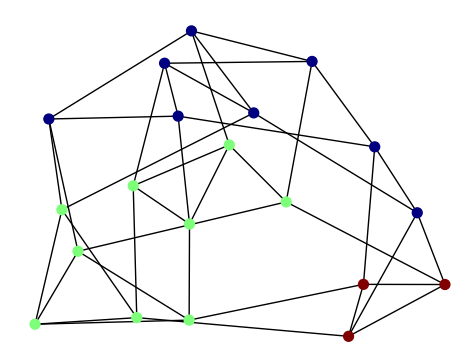
A non-consensus equilibrium in a coordination game on an asymmetric network.
This repository contains a collection of tools for the analysis of an \(n\)-player, \(n\)-strategy coordination game on a network with neutral options. Considering the game as a dynamical system we describe orbits, equilibria, and stability.
The Class Orbit is a (non-unique) solution to the initial value problem. Given a initial strategy profile (which will later be thought of as partitions) and a graph, an instance of the class is produced by solving the IVP with the best response replicator dynamic. The solution is a list of arrays which represent the strategy each vertex in the graph is taking on at that time step.
Using the Orbit class we can describe equilibrium partitions (which are those partitions corresponding to equilibrium strategy profiles). SCCatalogue.py runs a script to find all equilibrium partitions among connected graphs in the networkx Graph Atlas.
SCBasinSim.py is a script which generates a random array of graphs and estimates the size of the basin of stability for the consensus equilibrium It has been parallelized to be run with the shell script JobBasinSim.srun.sh Likewise, SCBroadSim.py is a script which generates a random array of graphs and measures their limiting behavior. It also has been parallelized to run with the shell script JobBroadSim.srun.sh. The python script and shell script DataCollect.py and JobDataCollect.srun.sh take the slices of simulation data from the simulations mentioned above are compile it into one process.
PartitionTools.py is a collection of tools which are used in the simulations to measure partitions
SCCatalogue.py, SCBasinSim.py, SCBroadSim.py, and PartitionTools.py all depend on Orbit.py, SCBasinSim.py and SCBroadSim.py depends on PartitionTools.py
The Jupiter Notebook McAlisterProjectDemo.ipynb steps through the functionality of the Orbit class. (note the visualizations are not supported on when run in VScode)